
What tips can help teams effectively implement and maintain a hybrid Scrum with Kanban approach?
Posted bySCRUMstudy® on July 31, 2024
Categories Product Backlog Product Owner Release Scrum Scrum Team
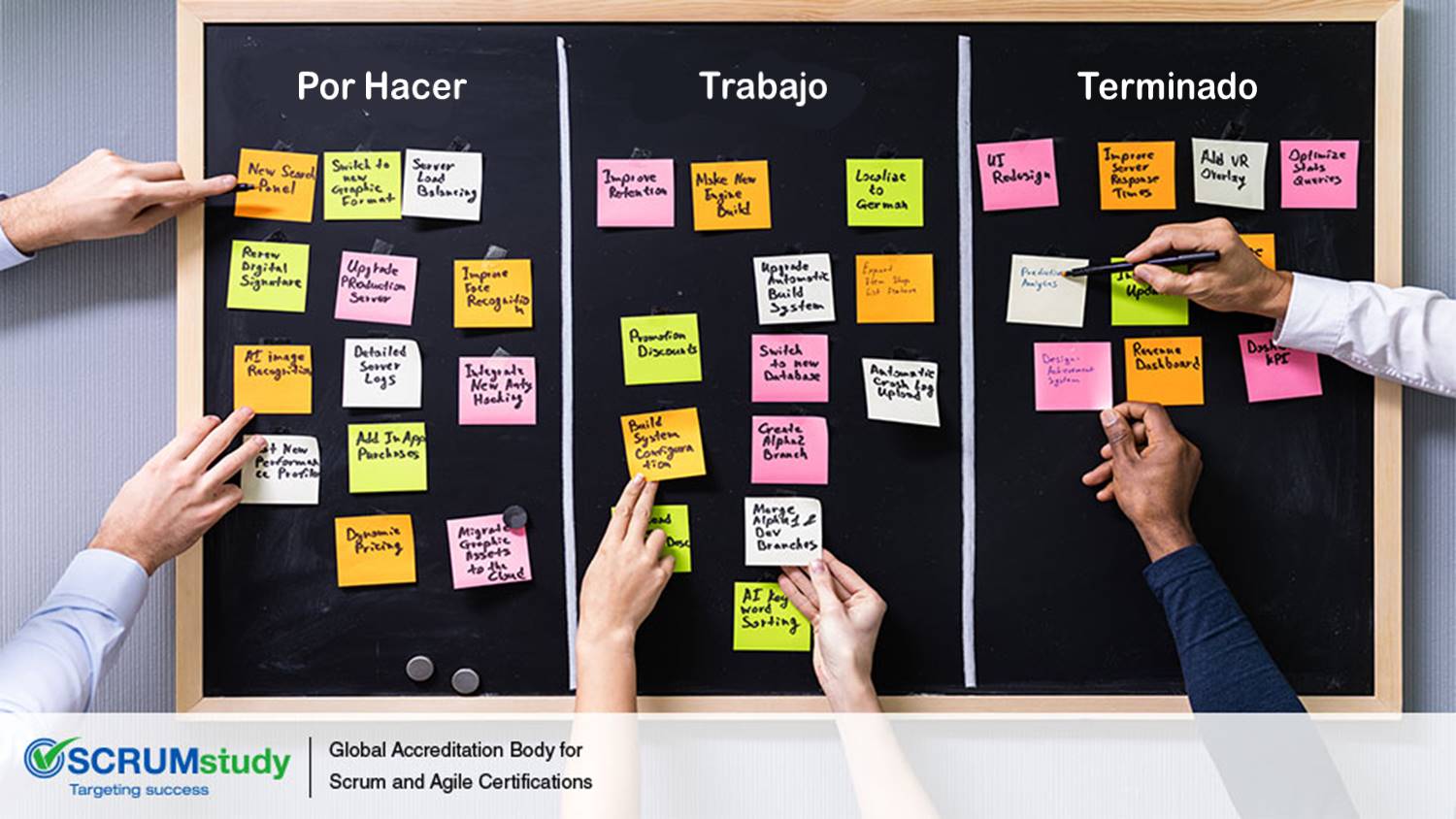
Scrum with Kanban best practices combine the strengths of both methodologies to optimize Agile project management. Key practices include visualizing workflow using Kanban boards to track tasks and identify bottlenecks, while adhering to Scrum's time-boxed iterations for planning and review. Utilizing WIP limits in Kanban ensures teams maintain focus and manage work-in-progress effectively, enhancing productivity and flow. Regular retrospectives enable teams to reflect on their process and implement continuous improvements.
One of the criteria for deciding between the Kanban or Scrum Agile frameworks can be the time required. One of these works well when there is shortage of time in terms of deadlines; the other one works well in situations where more time is required to carry out tasks, when a diminutive iteration cannot satisfy the work. Testing should be carried out at all levels and processes such as perpetual testing raise the level of quality in terms of software, code or other product.
Kanban processes can enable enhancement of the quality of software from its commencement till project delivery. The reason, as we know, is because of its focus on system thinking. Kanban restricts the capacity of tasks which can be found anywhere in the complete cycle of the work-in-progress limit. This can be advantageous too as total focus can be directed towards solitary work packages one at a time thus ensuring the quality of the outcome. In situations entailing releases within a short time period, Kanban is a good choice as since total focus is given toward single tasks, rendering them ‘completed’ once they are finished. So, Kanban works fine in this type of scenario.
Good quality is what one can see with relation to the work right from the conception to the end. Understanding the requirements, design related with transitioning activities, development activities, testing and releasing is how the Kanban workflow operates right from the conceptual stage.
Project managers often prefer Scrum more than Kanban. Scrum has a close affinity with project managers and business stakeholders due to its presentation of processes and events. The workflows in both frameworks are alike, with the only exception being that Scrum has better demarcated deadlines.
Segregation of the quantity of work that would be possible to be done within a particular time frame is one of the advantages of using Scrum.
Both approaches provide more or less effective change management in the sense that they have similar learning curves, focus, progress and change.
What tips can help teams effectively implement and maintain a hybrid Scrum with Kanban approach?
Posted bySCRUMstudy® on July 31, 2024
Categories Product Backlog Product Owner Release Scrum Scrum Team
Scrum with Kanban best practices combine the strengths of both methodologies to optimize Agile project management. Key practices include visualizing workflow using Kanban boards to track tasks and identify bottlenecks, while adhering to Scrum's time-boxed iterations for planning and review. Utilizing WIP limits in Kanban ensures teams maintain focus and manage work-in-progress effectively, enhancing productivity and flow. Regular retrospectives enable teams to reflect on their process and implement continuous improvements.
One of the criteria for deciding between the Kanban or Scrum Agile frameworks can be the time required. One of these works well when there is shortage of time in terms of deadlines; the other one works well in situations where more time is required to carry out tasks, when a diminutive iteration cannot satisfy the work. Testing should be carried out at all levels and processes such as perpetual testing raise the level of quality in terms of software, code or other product.
Kanban processes can enable enhancement of the quality of software from its commencement till project delivery. The reason, as we know, is because of its focus on system thinking. Kanban restricts the capacity of tasks which can be found anywhere in the complete cycle of the work-in-progress limit. This can be advantageous too as total focus can be directed towards solitary work packages one at a time thus ensuring the quality of the outcome. In situations entailing releases within a short time period, Kanban is a good choice as since total focus is given toward single tasks, rendering them ‘completed’ once they are finished. So, Kanban works fine in this type of scenario.
Good quality is what one can see with relation to the work right from the conception to the end. Understanding the requirements, design related with transitioning activities, development activities, testing and releasing is how the Kanban workflow operates right from the conceptual stage.
Project managers often prefer Scrum more than Kanban. Scrum has a close affinity with project managers and business stakeholders due to its presentation of processes and events. The workflows in both frameworks are alike, with the only exception being that Scrum has better demarcated deadlines.
Segregation of the quantity of work that would be possible to be done within a particular time frame is one of the advantages of using Scrum.
Both approaches provide more or less effective change management in the sense that they have similar learning curves, focus, progress and change.
Scrum with Kanban Approach
Posted bySCRUMstudy® on June 17, 2024
Categories SBOK® Guide

Scrum with Kanban approach offers a powerful approach to project management, integrating the structured framework of Scrum with the flexibility of Kanban. This hybrid method enhances productivity and efficiency by maintaining Scrum's iterative cycles while leveraging Kanban's visual workflow management. Teams benefit from improved transparency, faster delivery times, and the ability to handle unexpected changes more effectively. Embracing both methodologies allows for a more adaptable and responsive project environment, ultimately leading to better outcomes and higher customer satisfaction.
Scrum and Kanban have evolved from the agile methodology, each offering distinct approaches while remaining firmly rooted in agile software development principles. Scrum is particularly effective for projects with periodic releases, whereas Kanban shines in environments requiring frequent releases. Typically, Scrum is favored for product development projects, while Kanban serves as a valuable visual management tool, especially in production support scenarios. Combining the strengths of both methodologies results in Scrumban, an upgraded process that integrates the best practices of Scrum and Kanban. Scrumban represents an enhanced and refined approach to agile software development.
Before we discuss how Scrum and Kanban are integrated in the Scrumban process, will have a quick look at some of the salient features of scrum and Kanban.
Implementing Scrum means:
- Breaking the entire organization into cross-functional several teams.
- Breaking down the entire project into small chunks of well-defined deliverables.
- Listing the chunks in terms of priority and estimating the amount of work required to complete each one of them.
- Splitting time into short periods (iterations) where market-ready code is presented.
- Working on the release plan based on the review and feedback after the iteration.
- Enhancing the process with the help of retrospection after the iteration.
Speaking of the workflow in scrum, the team plans and decides on the work that it will be completed in the upcoming sprint. Once decided, the sprint activities are finalized and are finished within the sprint duration, clearing the queue.
Now we will look at the features of Kanban:
- Breaking down work into items, writing each item on a card and then sticking it on a wall.
- Using designated columns to show the placement of each item in the workflow.
- Limiting the work in progress by allocating clear limits on the number of items that may be in progress at each workflow level.
- Measuring the time needed to complete an item and trying to the lead time as predictable as possible.
When it comes to the Kanban workflow, the limit on work in progress enables the team to change items in queues whenever it is needed. There’s no clearing the queue, and there is a continuous flow of work.
How are Scrum and Kanban integrated as Scrumban?
Scrumban blends the principles of Scrum with the tools of Kanban for enhanced process efficiency. While originally rooted in different methodologies, the mechanics of Scrum and Kanban seamlessly complement each other. By incorporating concepts like Work In Progress (WIP) limits and visual workflows, Scrumban facilitates continuous process enhancement. Unlike traditional Scrum, where iteration planning fills predetermined slots, Scrumban adapts by filling vacant slots with iteration planning as needed, reducing the overhead of planning sessions. Essentially, Scrumban embodies the practicality of Scrum with the cultural ethos of Kanban.
Integrating the two agile processes leads to several advantages in terms of quality, just-in-time delivery, short lead time, continuous improvement (also known as Kaizen in Kanban terminology), reducing waste and overall process improvement.
Though Scrumban is a relatively new approach in agile, it is gaining quite a lot of popularity and attention from industries that have to cater to both development and maintenance work.
Here are some areas where Scrumban can be implanted in order to achieve success:
- Projects related to maintenance
- Projects that require event -driven work
- Projects that are prone to programming errors
- Teams created to mainly work on developing new products