
What key elements should be included in a Scrum training course to ensure it effectively prepares participants for implementing Scrum practices and achieving certification?
Posted bySCRUMstudy® on August 02, 2024
Categories Agile Certification Scrum Training
A Scrum training course is an educational program designed to teach participants the fundamentals and advanced practices of the Scrum framework, a key component of Agile project management. The course typically covers essential topics such as Scrum roles (Scrum Master, Product Owner, and Development Team), artifacts (Product Backlog, Sprint Backlog, and Increment), and ceremonies (Sprint Planning, Daily Stand-up, Sprint Review, and Retrospective).
Embark on a transformative journey of Agile Scrum mastery with our comprehensive online training course. Designed for individuals and teams eager to navigate the complexities of modern project management, our program offers a dynamic blend of theory and practical application. Dive into the Agile principles, Scrum framework, and iterative methodologies that empower teams to adapt, innovate, and deliver value with unparalleled efficiency. Led by seasoned industry experts, our interactive sessions foster collaborative learning, equipping participants with the skills and mindset necessary to thrive in today's fast-paced digital landscape. Join us and unleash your potential to drive meaningful change and achieve exceptional results.
Gain expertise in Agile project management with our Agile Scrum Master Certification Online Course. This comprehensive program equips you with the essential skills and knowledge required to lead Agile teams effectively, ensuring successful project delivery. Learn the fundamentals of the Scrum framework, including roles, events, and artifacts, and master Agile principles to drive innovation and adaptability in your organization. With interactive modules, real-world case studies, and practical exercises, this course prepares you for the Agile Scrum Master Certification exam, empowering you to advance your career and become a valuable asset in today's dynamic business landscape.
The Scrum Master Certification Course offered by ScrumStudy equips individuals with the essential knowledge and skills to excel in the role of a Scrum Master. Through comprehensive training modules, participants delve into the principles and practices of Scrum methodology, understanding its iterative and incremental approach to project management. The course covers key concepts such as Sprint planning, Daily Stand-ups, Sprint Reviews, and Retrospectives, empowering candidates to effectively facilitate Scrum ceremonies and foster collaboration within Agile teams. With a focus on real-world scenarios and practical applications, this certification course enables aspiring Scrum Masters to navigate complexities, drive productivity, and champion Agile values in their organizations.
SCRUMstudy offers comprehensive Scrum Certification Classroom Training designed to provide an in-depth understanding of Scrum principles and practices. Led by experienced instructors, these interactive sessions ensure participants gain practical knowledge and hands-on experience. The training covers essential Scrum concepts, including roles, events, and artifacts, and prepares attendees for certification exams. By participating, individuals and teams can enhance their Agile skills, improve project delivery, and contribute more effectively to their organizations.
The Scaled Scrum Master Certification (SSMC™) Online, is designed for Scrum professionals who aim to extend their expertise in scaling Scrum across multiple teams and complex projects. This certification equips practitioners with advanced skills to coordinate, manage, and implement Scrum processes effectively at an enterprise level. The SSMC™ curriculum covers essential topics such as managing distributed teams, synchronizing multiple Scrum teams, and handling intricate project dynamics, ensuring that participants can drive agile transformation and deliver substantial business value in large-scale environments.
Scrum Certification Professional Development focuses on enhancing skills and knowledge in Scrum, a popular Agile framework for managing complex projects. It involves earning certifications most popular being Scrum Master Certified (SMC) and Scrum Product Owner Certified (SPOC). These certifications validate one's expertise in Scrum principles, practices, and methodologies. Professional development in this field includes attending workshops, participating in training courses, engaging in practical Scrum projects, and continuous learning through reading and community involvement. It aims to improve one's ability to facilitate, implement, and optimize Scrum processes, leading to more efficient project delivery and higher quality outcomes.
It is often seen that Agile has been implemented successfully in different projects. But when it comes to Product Management or NPD (New Product Development), many people get sceptical regarding implementation of Agile. Now it has to be understood that Agile is not a methodology which can be used in a cookie cutter way across any organization. A lot of tweaking and customization is required to make it work. So, in product management, a proper assessment is required to see if Agile implementation will improve performance or not.
Here also, we need to see if the following two criteria are being fulfilled or not:
- Requirement Volatility : It is important to identify the volatility of requirements and whether working in Sprint will actually improve customer satisfaction, reduce uncertainty and help PM teams become more productive or not. If requirements are fixed in sand and are not dynamic in nature, it will not make any marked improvement even if the teams work in sprint. Also, Agile Product Life Cycle Management involves a lot of new learning, so it needs to be checked if the team will be comfortable in this transition or not.
- Frequent customer Interaction: External customers are big stakeholders in any Agile effort. In many product management scenarios, we have seen that customers just give their specifications and just go away for months and months. And finally when they come back for the product, it is completely different from what they expected, because market dynamics change and the expectations change as well. So the biggest benefit is actually to the customers themselves, and this is what the PM team should explain in details to the customers so as to get their buy in. Without their pro-active support, it will not be possible to implement Agile in any way.
If we are talking about New Product Development, then Agile actually becomes even more crucial and important. That is because neither the customers nor the PM team has any benchmark to follow. So, frequent discussions and brain storming sessions followed by change in requirements or prototypes will be mandatory for successful NPD. So, it is important to realize that Agile can be implemented successfully in Product Management as well, provided it is understood properly and used in the proper context. Also, management buy-in and customer buy-in are important components in this scenario, and a good AGILE coach will also be very beneficial.
What are the key benefits of enrolling in an online Agile Scrum training course compared to traditional in-person training?
Posted bySCRUMstudy® on July 22, 2024
Categories Agile Certification Scrum Training

Embark on a transformative journey of Agile Scrum mastery with our comprehensive online training course. Designed for individuals and teams eager to navigate the complexities of modern project management, our program offers a dynamic blend of theory and practical application. Dive into the Agile principles, Scrum framework, and iterative methodologies that empower teams to adapt, innovate, and deliver value with unparalleled efficiency. Led by seasoned industry experts, our interactive sessions foster collaborative learning, equipping participants with the skills and mindset necessary to thrive in today's fast-paced digital landscape. Join us and unleash your potential to drive meaningful change and achieve exceptional results.
Gain expertise in Agile project management with our Agile Scrum Master Certification Online Course. This comprehensive program equips you with the essential skills and knowledge required to lead Agile teams effectively, ensuring successful project delivery. Learn the fundamentals of the Scrum framework, including roles, events, and artifacts, and master Agile principles to drive innovation and adaptability in your organization. With interactive modules, real-world case studies, and practical exercises, this course prepares you for the Agile Scrum Master Certification exam, empowering you to advance your career and become a valuable asset in today's dynamic business landscape.
The Scrum Master Certification Course offered by ScrumStudy equips individuals with the essential knowledge and skills to excel in the role of a Scrum Master. Through comprehensive training modules, participants delve into the principles and practices of Scrum methodology, understanding its iterative and incremental approach to project management. The course covers key concepts such as Sprint planning, Daily Stand-ups, Sprint Reviews, and Retrospectives, empowering candidates to effectively facilitate Scrum ceremonies and foster collaboration within Agile teams. With a focus on real-world scenarios and practical applications, this certification course enables aspiring Scrum Masters to navigate complexities, drive productivity, and champion Agile values in their organizations.
SCRUMstudy offers comprehensive Scrum Certification Classroom Training designed to provide an in-depth understanding of Scrum principles and practices. Led by experienced instructors, these interactive sessions ensure participants gain practical knowledge and hands-on experience. The training covers essential Scrum concepts, including roles, events, and artifacts, and prepares attendees for certification exams. By participating, individuals and teams can enhance their Agile skills, improve project delivery, and contribute more effectively to their organizations.
The Scaled Scrum Master Certification (SSMC™) Online, is designed for Scrum professionals who aim to extend their expertise in scaling Scrum across multiple teams and complex projects. This certification equips practitioners with advanced skills to coordinate, manage, and implement Scrum processes effectively at an enterprise level. The SSMC™ curriculum covers essential topics such as managing distributed teams, synchronizing multiple Scrum teams, and handling intricate project dynamics, ensuring that participants can drive agile transformation and deliver substantial business value in large-scale environments.
Scrum Certification Professional Development focuses on enhancing skills and knowledge in Scrum, a popular Agile framework for managing complex projects. It involves earning certifications most popular being Scrum Master Certified (SMC) and Scrum Product Owner Certified (SPOC). These certifications validate one's expertise in Scrum principles, practices, and methodologies. Professional development in this field includes attending workshops, participating in training courses, engaging in practical Scrum projects, and continuous learning through reading and community involvement. It aims to improve one's ability to facilitate, implement, and optimize Scrum processes, leading to more efficient project delivery and higher quality outcomes.
It is often seen that Agile has been implemented successfully in different projects. But when it comes to Product Management or NPD (New Product Development), many people get sceptical regarding implementation of Agile. Now it has to be understood that Agile is not a methodology which can be used in a cookie cutter way across any organization. A lot of tweaking and customization is required to make it work. So, in product management, a proper assessment is required to see if Agile implementation will improve performance or not.
Here also, we need to see if the following two criteria are being fulfilled or not:
- Requirement Volatility : It is important to identify the volatility of requirements and whether working in Sprint will actually improve customer satisfaction, reduce uncertainty and help PM teams become more productive or not. If requirements are fixed in sand and are not dynamic in nature, it will not make any marked improvement even if the teams work in sprint. Also, Agile Product Life Cycle Management involves a lot of new learning, so it needs to be checked if the team will be comfortable in this transition or not.
- Frequent customer Interaction: External customers are big stakeholders in any Agile effort. In many product management scenarios, we have seen that customers just give their specifications and just go away for months and months. And finally when they come back for the product, it is completely different from what they expected, because market dynamics change and the expectations change as well. So the biggest benefit is actually to the customers themselves, and this is what the PM team should explain in details to the customers so as to get their buy in. Without their pro-active support, it will not be possible to implement Agile in any way.
If we are talking about New Product Development, then Agile actually becomes even more crucial and important. That is because neither the customers nor the PM team has any benchmark to follow. So, frequent discussions and brain storming sessions followed by change in requirements or prototypes will be mandatory for successful NPD. So, it is important to realize that Agile can be implemented successfully in Product Management as well, provided it is understood properly and used in the proper context. Also, management buy-in and customer buy-in are important components in this scenario, and a good AGILE coach will also be very beneficial.
Scrum training course
Posted bySCRUMstudy® on June 20, 2024
Categories Agile Certification Scrum Training
A Scrum training course is an educational program designed to teach participants the fundamentals and advanced practices of the Scrum framework, a key component of Agile project management. The course typically covers essential topics such as Scrum roles (Scrum Master, Product Owner, and Development Team), artifacts (Product Backlog, Sprint Backlog, and Increment), and ceremonies (Sprint Planning, Daily Stand-up, Sprint Review, and Retrospective).
Embark on a transformative journey of Agile Scrum mastery with our comprehensive online training course. Designed for individuals and teams eager to navigate the complexities of modern project management, our program offers a dynamic blend of theory and practical application. Dive into the Agile principles, Scrum framework, and iterative methodologies that empower teams to adapt, innovate, and deliver value with unparalleled efficiency. Led by seasoned industry experts, our interactive sessions foster collaborative learning, equipping participants with the skills and mindset necessary to thrive in today's fast-paced digital landscape. Join us and unleash your potential to drive meaningful change and achieve exceptional results.
Gain expertise in Agile project management with our Agile Scrum Master Certification Online Course. This comprehensive program equips you with the essential skills and knowledge required to lead Agile teams effectively, ensuring successful project delivery. Learn the fundamentals of the Scrum framework, including roles, events, and artifacts, and master Agile principles to drive innovation and adaptability in your organization. With interactive modules, real-world case studies, and practical exercises, this course prepares you for the Agile Scrum Master Certification exam, empowering you to advance your career and become a valuable asset in today's dynamic business landscape.
The Scrum Master Certification Course offered by ScrumStudy equips individuals with the essential knowledge and skills to excel in the role of a Scrum Master. Through comprehensive training modules, participants delve into the principles and practices of Scrum methodology, understanding its iterative and incremental approach to project management. The course covers key concepts such as Sprint planning, Daily Stand-ups, Sprint Reviews, and Retrospectives, empowering candidates to effectively facilitate Scrum ceremonies and foster collaboration within Agile teams. With a focus on real-world scenarios and practical applications, this certification course enables aspiring Scrum Masters to navigate complexities, drive productivity, and champion Agile values in their organizations.
SCRUMstudy offers comprehensive Scrum Certification Classroom Training designed to provide an in-depth understanding of Scrum principles and practices. Led by experienced instructors, these interactive sessions ensure participants gain practical knowledge and hands-on experience. The training covers essential Scrum concepts, including roles, events, and artifacts, and prepares attendees for certification exams. By participating, individuals and teams can enhance their Agile skills, improve project delivery, and contribute more effectively to their organizations.
The Scaled Scrum Master Certification (SSMC™) Online, is designed for Scrum professionals who aim to extend their expertise in scaling Scrum across multiple teams and complex projects. This certification equips practitioners with advanced skills to coordinate, manage, and implement Scrum processes effectively at an enterprise level. The SSMC™ curriculum covers essential topics such as managing distributed teams, synchronizing multiple Scrum teams, and handling intricate project dynamics, ensuring that participants can drive agile transformation and deliver substantial business value in large-scale environments.
Scrum Certification Professional Development focuses on enhancing skills and knowledge in Scrum, a popular Agile framework for managing complex projects. It involves earning certifications most popular being Scrum Master Certified (SMC) and Scrum Product Owner Certified (SPOC). These certifications validate one's expertise in Scrum principles, practices, and methodologies. Professional development in this field includes attending workshops, participating in training courses, engaging in practical Scrum projects, and continuous learning through reading and community involvement. It aims to improve one's ability to facilitate, implement, and optimize Scrum processes, leading to more efficient project delivery and higher quality outcomes.
It is often seen that Agile has been implemented successfully in different projects. But when it comes to Product Management or NPD (New Product Development), many people get sceptical regarding implementation of Agile. Now it has to be understood that Agile is not a methodology which can be used in a cookie cutter way across any organization. A lot of tweaking and customization is required to make it work. So, in product management, a proper assessment is required to see if Agile implementation will improve performance or not.
Here also, we need to see if the following two criteria are being fulfilled or not:
- Requirement Volatility : It is important to identify the volatility of requirements and whether working in Sprint will actually improve customer satisfaction, reduce uncertainty and help PM teams become more productive or not. If requirements are fixed in sand and are not dynamic in nature, it will not make any marked improvement even if the teams work in sprint. Also, Agile Product Life Cycle Management involves a lot of new learning, so it needs to be checked if the team will be comfortable in this transition or not.
- Frequent customer Interaction: External customers are big stakeholders in any Agile effort. In many product management scenarios, we have seen that customers just give their specifications and just go away for months and months. And finally when they come back for the product, it is completely different from what they expected, because market dynamics change and the expectations change as well. So the biggest benefit is actually to the customers themselves, and this is what the PM team should explain in details to the customers so as to get their buy in. Without their pro-active support, it will not be possible to implement Agile in any way.
If we are talking about New Product Development, then Agile actually becomes even more crucial and important. That is because neither the customers nor the PM team has any benchmark to follow. So, frequent discussions and brain storming sessions followed by change in requirements or prototypes will be mandatory for successful NPD. So, it is important to realize that Agile can be implemented successfully in Product Management as well, provided it is understood properly and used in the proper context. Also, management buy-in and customer buy-in are important components in this scenario, and a good AGILE coach will also be very beneficial.
Scrum training courses
Posted bySCRUMstudy® on April 03, 2024
Categories Agile SBOK® Guide Scrum Scrum Guide Training
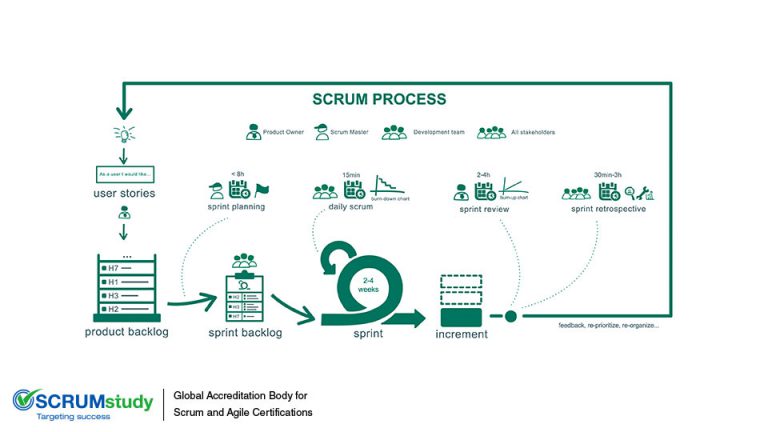
Scrum training courses play a pivotal role in equipping individuals and organizations with the essential knowledge and skills to embrace the Scrum framework effectively. Drawing from the Scrum Body of Knowledge (SBOK GUIDE), these courses provide a comprehensive understanding of Scrum principles, practices, and roles. Participants delve into the iterative and incremental approach to product development, learning how to maximize value through collaboration, transparency, and adaptation. From Scrum Masters facilitating seamless team processes to Product Owners steering product vision, these courses cater to diverse roles within the Scrum ecosystem. With hands-on exercises, real-world case studies, and interactive sessions, attendees not only grasp theoretical concepts but also cultivate practical expertise essential for navigating complex projects. Whether novice or seasoned professional, Scrum training courses serve as a catalyst for continuous improvement, fostering a culture of agility and innovation within organizations.
Scrum is the most widely used Agile framework for developing and managing complex software and product applications. In its simplest terms, Scrum is characterized by its core values of Plan Ahead and Inspect & Adapt. Therefore, Scrum successfully manages projects in which there is marked uncertainty and ambiguity at the early stages of the project.
With Scrum, an entire project is split into a sequence of iterations called Sprints. Each Sprint is time-boxed for not more than one month and planned well in advance. Planning is completed not according to a set of prescribed tools, but according to the requirements as decided by the Scrum team. As such, a self-organizing and a cross-functional team is the backbone of the Scrum method. In order to ensure maximum cooperation among team members, face-to-face communication is encouraged. Also, the Business stakeholders and the technical team work in close collaboration, thereby ensuring the delivery of high-quality, working software.
The two keys roles in the Scrum team are those of Scrum Master and Product Owner. The latter represents the product users and customers while the former is the chief facilitator who steers the technical team in the right direction. These two people prepare a list of priority-based features, which is called the Scrum Product Backlog. These features are developed one by one in small, repetitive development cycles consisting of the phases such as coding, testing, integrating and delivering. At the end of each Sprint, a feedback session called a Sprint Review is held during which the team delivers the developed feature to the actual production scene, and the stakeholders provide feedback based on their evaluation of the feature. The feedback obtained during the Sprint Review Meeting provides teams with input that can be used during the next Sprint.
What is the recommended number of hours for online Scrum training courses?
Posted bySCRUMstudy® on October 11, 2023
Categories Agile Product Owner Scrum Scrum Master Scrum Principles Scrum Team
Scrum certifications are highly regarded in the realm of Agile project management, providing professionals with essential skills and knowledge to excel in their roles. Central to achieving these certifications are the Scrum certification hours, which play a crucial role in ensuring candidates meet the requirements for certification eligibility.
What Are Scrum Certification Hours?
Scrum certification hours refer to the specific hours of training or professional experience that candidates must accumulate to qualify for various Scrum certifications. These certifications, offered by organizations like SCRUMstudy, Scrum Alliance, and Scrum.org, validate an individual's understanding and application of Scrum principles and practices in real-world scenarios.
Types of Scrum Certifications
There are different levels of Scrum certifications, each requiring a varying number of Scrum certification hours:
-
Scrum Fundamentals Certified (SFC): This entry-level certification typically requires around 8 hours of training.
-
Scrum Developer Certified (SDC): Aspiring Scrum developers need to complete approximately 16 hours of training.
-
Scrum Master Certified (SMC): Scrum Masters, responsible for facilitating Agile teams, must accumulate about 16 hours of training.
-
Scrum Product Owner Certified (SPOC): Product Owners, tasked with maximizing product value, generally require 16 hours of training.
-
Scrum Agile Master Certified (SAMC): Advanced certification for Agile practitioners, necessitating approximately 16 hours of training.
Importance of Scrum Certification Hours
Accruing the required Scrum certification hours serves multiple purposes:
-
Knowledge Acquisition: The hours of training ensure candidates acquire comprehensive knowledge of Scrum principles, roles, and ceremonies.
-
Skill Development: Practical experience gained during these hours helps candidates hone their skills in Agile project management, fostering effective team collaboration and product delivery.
-
Credential Eligibility: Fulfilling the required hours is a prerequisite for sitting the certification exams, validating an individual’s proficiency in Scrum practices.
How to Accumulate Scrum Certification Hours
Professionals can accumulate Scrum certification hours through:
-
Formal Training: Attending accredited Scrum courses and workshops conducted by certified trainers.
-
Work Experience: Practicing Scrum principles in real-world projects under the guidance of a certified Scrum Master or Coach.
-
Self-Study: Participating in webinars, reading relevant literature, and engaging in online courses approved by certifying bodies.
Conclusion
In conclusion, Scrum certification hours are instrumental in preparing individuals for the challenges of Agile project management. By investing in training and practical experience, professionals not only fulfill certification requirements but also enhance their ability to lead successful Agile teams and deliver value-driven projects in dynamic business environments. For those aspiring to advance their careers in Agile and Scrum, accumulating the requisite hours is a pivotal step towards achieving certification and gaining recognition in the industry.