
How does Scrum facilitate product management in Agile?
Posted bySCRUMstudy® on August 14, 2024
Categories Agile Product Owner Scrum Scrum Master Training
In the realm of product management, continuous improvement is vital for success. This article delves into how Agile Retrospectives and Kaizen practices can revolutionize product development. By fostering a culture of ongoing enhancement and collaboration, these methodologies empower teams to refine processes, boost efficiency, and ultimately deliver superior products. Discover how integrating these principles can transform your product management approach and drive sustainable growth.
A gathering conducted toward the close of an iteration pertaining to Agile software development is known as an Agile retrospective. The team turns back and mentally goes through the different events that occurred during the iteration and then tries to contemplate the improvement steps to go ahead.
The following questions are being asked of each team member:
• What were the good things that worked fine for the team?
• What were the unfortunate things that didn’t go well for the team?
• What feasible options and steps can be taken to improve the team process in the future?
The Agile retrospective is similar to that of the review meetings conducted to learn the do’s and avoid the pitfalls. Lessons are learned from real past experience and the team focuses on the necessary changes needed for the subsequent iteration. This meeting of team members is powered by themselves as they are the ones who decide the ‘how’ part of running the meetings and improvement decisions.
A cordial and transparent atmosphere based on the foundation of trust is very much needed for team members to share their ideas and inputs in a relaxed manner. Primary importance is being given to continuous improvement in Agile development; hence conducting these Agile retrospective meetings should be ingrained among all members of the team as one of the most significant development practices of Agile.
How can obtaining a Professional Product Owner Certification enhance your career prospects and advancement opportunities in the field of product management?
Posted bySCRUMstudy® on August 09, 2024
Categories Agile SBOK® Guide Scaling Scrum Scrum Sprint Backlog
Obtaining a Product Owner Certification (SPOC) certification can significantly enhance a professional's career prospects in the agile and product management fields. This certification demonstrates a thorough understanding of Scrum principles, effective product ownership, and agile methodologies. As organizations increasingly adopt agile practices, the demand for certified Product Owners is on the rise. The SPOC certification signals to employers that the individual possesses the skills needed to manage product backlogs, prioritize work effectively, and deliver high-value products. Consequently, certified Product Owners often find greater job opportunities, higher earning potential, and a clear path for career advancement within agile organizations.
Product Owner certification (SPOC™) certification equips professionals with the expertise to manage stakeholders, articulate project vision, and ensure successful product delivery. This online certification emphasizes the critical role of the Product Owner in maximizing value through effective backlog management and stakeholder communication. Candidates gain comprehensive knowledge of Scrum principles, ensuring they can effectively prioritize tasks, make informed decisions, and drive project success in dynamic and complex environments.
The key Business stakeholder of Scrum Projects is the Product Owner One integral responsibility of the Product Owner is to convey the importance and significance of the Scrum Project to the Scrum Team. This is the key for the success of any Agile Project through the use of Product Backlog.
Now let us look at some of the major responsibilities of a Product Owner:
- Creation and Maintenance of the Product Backlog: Scrum framework is mostly used in the software environment and new product development field. This is an on-going job and full time responsibility of the Product Owner. He has to constantly keep refining it especially before any sprint planning meetings.
- Prioritizing of Backlog according to the Business ROI: Product Owner also needs to prioritize and sequence the backlog according to the needs of the business and situations.
- He also elaborates the epics, themes and features into user stories which are feasible enough to be achieved in a single sprint.
- The Product Owner does the job of continuously reminding the Team of the Sprint & Release and ensures that the team remains on track in realizing their goals.
- The Product Owner does the job of continuously engaging the customer and business stakeholders to ensure that the Team is building the right product and delivering the business value expected of it. Also at the end of every Sprint the Product Owner has the opportunity to steer the team in the direction which will create value for the business stakeholders.
- The Product Owner also keeps inspecting the work done by the Scrum Team at the end of every Sprint and has the absolute authority to accept or reject their work or to suggest modifications.
- Product owner also acts as the voice of the Team to the outside world and should ensure that all the channels of communication remains open and the project get the right kind and type of support needed to succeed.
- Has the authority to terminate a Sprint if the Product Owner feels that there is drastic change in direction needed and the Sprint is no longer needed. It may happen in cases where the competitor releases a new product and the client wants a counter response.
The responsibilities of a Product Owner is onerous and there are a lot of hats that have to be worn by him hence choice of a Product Owner must be done wisely as it could lead to success or failure for the entire project which ultimately affect the success or failure of the company.
What are the key advantages of earning a Professional Product Owner Certification for someone looking to excel in product management roles?
Posted bySCRUMstudy® on August 09, 2024
Categories Agile Product Backlog Product Development Product Owner Scrum
The Scrum Product Owner Certification (SPOC) certification offers numerous advantages for individuals pursuing a career in agile product management. Firstly, it provides a robust validation of one’s expertise in Scrum practices and principles, which is highly valued in today's agile-centric work environments. This certification helps individuals gain a comprehensive understanding of product ownership, from managing product backlogs to stakeholder communication and prioritizing work to maximize value. Furthermore, SPOC certification can significantly enhance career opportunities, as it is recognized globally by employers seeking skilled Product Owners. Certified professionals often enjoy increased job security, higher earning potential, and a competitive edge in the job market. Additionally, the certification process fosters continuous learning and professional growth, keeping individuals up-to-date with the latest agile practices and industry trends.
Scrum Product Owner Certification is a specialized credential that validates an individual's expertise in the Scrum framework, particularly in the role of a Product Owner. This certification demonstrates a thorough understanding of managing the product backlog, prioritizing features based on business value, and ensuring that the development team delivers products that meet customer needs and business goals.
The Product Owner represents the interests of the stakeholder community to the Scrum Team. He/she ensures clear communication of product or service functionality requirements to the Scrum Team, maintains a dual view, understands and supports the needs and interests of all Business stakeholders, while also understanding the needs and workings of the Scrum Team.
Product Owner must understand the needs and priorities of the Business stakeholders, including customers and users, and hence this role is commonly referred to as the Voice of the Customer.
Responsibilities of a Product Owner include determining the project’s initial overall requirements and kicking off project activities; this may involve interaction with the Program Product Owner and the Portfolio Product Owner to ensure that the project aligns with direction provided by senior management. He represents user(s) of the product or service with a thorough understanding of the user community. He secures the initial and ongoing financial resources for the project, focusing on value creation and overall Return on Investment (ROI) and assesses the viability and ensures the delivery of the product or service.
He also defines the Project Vision and helps get funding for the Project, helps finalize Scrum Master for the project and identifies Business Stakeholder(s), helps develop a Collaboration Plan and Team Building Plan with Scrum Master(s), creates Epic(s) and Personas, prioritizes Prioritized Product Backlog Items, defines Done Criteria, creates Release Planning Schedule, helps determine Length of Sprint, helps create User Stories, defines Acceptance Criteria for every User Story, approves User Stories, facilitates Scrum Team and commit User Stories, explains User Stories to the Scrum Team while creating the Task List.
He also provides guidance and clarification to the Scrum Team in estimating effort for tasks, accepts/Rejects Deliverables, provides necessary feedback to Scrum Master and Scrum Teams, updates Release Plan and Prioritized Product Backlog, helps deploy Product Releases and coordinates this with the customer, participates in Retrospective Sprint Meetings.
Challenges faced by a Product Owner:
Transforming customer’s ideas into tangible product deliverables: Prioritizing features is not always easy and may involve trade-off decision making. Convincing/achieving consensus among all stakeholders for every decision is tricky. Product Owner needs to be in control and trusted by the Business stakeholders to effectively play his role.
Be available when additional inputs are required by the team: The Product Owner needs to achieve consensus among various Business stakeholders and keep them in the loop. Product Owner may be involved in business value related activities that may keep him occupied.The Product Owner may not be always available at the team location.
Plan release and sprints to deliver maximum value at the earliest: The balancing act that the Product Owner plays between the Scrum Team and the Customer is a delicate one. The Scrum team may prefer a Release Planning Schedule and Sprint lengths which may differ from what the customer wants. It’s the Product Owner’s job to ensure that the maximum value is delivered as early as possible ensuring better ROI to the customer.
Articulating the customer’s requirements and project goal to the team: The Scrum Team may not have the requisite domain expertise of the customer’s field. The point of view of the Scrum Team’s and the Customer’s may tend to be different. Having clearly defined Acceptance Criteria for all functionalities is challenging but an essential requirement for high quality project deliverables.
Aligning the Scrum Team with the customer’s requirements: The team is composed of technical professionals and may have a skewed perspective from the business side/stakeholders. The team faces different constraints than those faced by those focusing on business value. The team may be in a different location and may be far removed from the users/customers.
Provide timely and constructive feedback to the team to improve quality of deliverables: Honest and transparent feedback is necessary but may not be always convenient to give. Not taking the Sprint Review seriously enough may lead to massive backlog of issues prior to release.
Dealing with customers who do not understand the process of Scrum: Customers may be invested in traditional project management techniques. Customers will want to nail down scope, budget and time. Customers may have little or no exposure to Scrum, leading to misconceptions and false expectations. Customers may not appreciate the principles and concepts behind Scrum.
What are the core principles of the Professional Product Owner role, and how do they guide effective product management?
Posted bySCRUMstudy® on August 09, 2024
Categories Agile Product Owner Scrum Scrum Guide Scrum Master Scrum Team
Professional Product Owners adhere to key principles that guide their approach to agile product management. Firstly, they prioritize maximizing the value delivered to customers and stakeholders by continually refining and prioritizing the product backlog. This involves understanding market needs, gathering user feedback, and aligning development efforts with business objectives.
Secondly, effective communication and collaboration are essential. Product Owners work closely with cross-functional teams, stakeholders, and customers to ensure a shared understanding of priorities and requirements. Clear communication fosters transparency and builds trust within the team and with external stakeholders.
Thirdly, Professional Product Owners embrace flexibility and responsiveness to change. They understand that requirements evolve over time, and they adapt plans and priorities accordingly to deliver incremental value and respond to market dynamics swiftly.
Moreover, Product Owners advocate for continuous improvement and learning. They regularly reflect on their practices, seek feedback from stakeholders, and stay informed about industry trends and best practices in agile product management.
By upholding these principles, Professional Product Owners not only enhance their effectiveness in driving successful product development but also contribute to the overall agility and innovation of their organizations.
Product Owner Principles revolve around the critical responsibilities of defining and prioritizing the product backlog to maximize value for the stakeholders. The Product Owner acts as the voice of the customer, ensuring that the development team understands the requirements clearly and delivers features that meet market needs. They are accountable for setting a clear vision for the product, making decisions regarding the scope of releases, and continuously engaging with stakeholders to gather feedback and make necessary adjustments.
Before we read about how to be an effective product owner, let us first understand who a product owner is and what he/she does. A product owner is not a separate title but is a role that can be performed by a business analyst or even a representative of an end user.
A product owner is a stakeholder who acts as an interface between the business representatives and the project team. A product owner understands the business requirements and communicates it to the team for development on behalf of the customer. A product owner is responsible for creating a priority list of backlogs, attending daily sprint meetings and steering the development process successfully to meet the customers requirements. The product owner communicates the progress of the team and continuously refines product requirements. It is also important that a product owner have a good business sense which is important while prioritizing user stories based on cost and functionality.
A product owner must be actively involved-
The test of an effective product leader is how well he/she balances the expectations of business representatives and capability of the team to deliver. There are several ways a product can be more effective. A common mistake product owners make is not committing enough time to be involved with the team. Product owners should be as hands-on as possible and schedule sufficient time to holding estimation workshops, planning sprints, and providing feedback for the team.
An empowered product owner nurtures an empowered team-
Customers most often expect more value to be delivered than the teams throughput or might suggest several changes that can slowdown the speed of the development team. A product owner supports his team by managing customers expectations so that workflow is not affected due to unreasonable expectations. A product owner allows the team to estimate the time required to complete the backlog identified for a particular sprint. At the same time, a product owner motivates the team to deliver the backlog of a sprint on time.
Technical knowledge is essential-
It is also important that product owners have some technical knowledge, though he/she does not necessarily have to be a developer themselves. Since, they will be interacting with the team on a regular basis, having a technical background can serve well while resolving issues. Technical knowledge can also help a product owner bridge the gap between the technical and business aspects of a project while liaising with developers and business representatives.
A product owner is similar to the role played by a Chief Engineer in Toyota. The Chief Engineer collects requirements and executes them during production, even taking some decisions on their own.
What are some key features to look for in Agile product management tools to effectively manage product backlogs and track progress?
Posted bySCRUMstudy® on August 05, 2024
Categories Agile Product Owner SBOK® Guide Scrum Guide Scrum Team
Agile Product Management Tools are essential resources for modern product development teams seeking to streamline their workflows, enhance collaboration, and deliver value to customers efficiently. These tools are designed to support Agile principles and methodologies, enabling teams to manage product backlogs, prioritize features, track progress, and gather feedback effectively. Examples of Agile Product Management Tools include Jira, Trello, Asana, Rally, Targetprocess, and Productboard, among others. These tools provide features such as user story management, sprint planning, burndown charts, and integration with other software development tools. By leveraging Agile Product Management Tools, teams can increase transparency, adaptability, and responsiveness, ultimately delivering products that better meet customer needs and market demands. These tools play a crucial role in fostering collaboration among cross-functional teams, enabling them to work cohesively towards achieving product goals.
Agile Team Management Tools encompass a range of techniques and practices tailored to enhance collaboration, productivity, and adaptability within Agile teams. These tools include Daily Stand-up Meetings, Sprint Planning Meetings, Retrospective Meetings, and Kanban boards. Daily Stand-ups facilitate daily synchronization and progress updates, ensuring transparency and alignment among team members. Sprint Planning Meetings enable teams to define sprint goals and commit to deliverables, fostering clarity and accountability. Retrospective Meetings promote continuous improvement by reviewing past sprints to identify successes and areas for enhancement. Kanban boards visually represent work items and their status, facilitating workflow management and task prioritization. Together, these tools support Agile principles of iterative development, customer collaboration, and rapid response to change, essential for successful project outcomes.
Open communication and transparency play crucial role in Scrum projects. Unlike the popular view that most meetings are waste of time, Scrum lays a lot of emphasis on conducting highly focused, time-boxed and effective meetings to allow transparency and free flow of information.
In this article we are going to briefly look at some of the more important meetings in Scrum.
Prioritized Product Backlog Review Meetings
The Product Owner may have multiple and separate meetings with relevant Business Stakeholder(s), the Scrum Master, and the Scrum Team to ensure that he or she has enough information to make updates to the Prioritized Product Backlog. The intent of the Prioritized Product Backlog Review Meetings is to ensure that User Stories and Acceptance Criteria are understood and are written properly by the Product Owner so that they reflect the actual business stakeholder (customer) requirements and priorities; User Stories are understood by everyone in the Scrum Team; and that high priority User Stories are well-refined so that the Scrum Team can properly estimate and commit to such User Stories.
Sprint Planning Meeting
In Sprint Planning Meetings, the Scrum Team gets together to plan the work to be done in the Sprint. The team reviews the Estimated User Stories at the top of the Prioritized Product Backlog. The Product Owner is present during this meeting in case clarification of User Stories or priorities are required. To help ensure that the group stays on topic, this meeting should be Time-boxed, with the standard length limited to two hours per week of Sprint duration. This assists in preventing the tendency to stray into discussions that should actually occur in other meetings, like the Release Planning or Sprint Review Meetings. As part of this meeting the entire Scrum Team will commit to delivering a subset of User Stories from the Prioritized Product Backlog in the Sprint.
Daily Standup Meeting
The Daily Standup Meeting is a short daily meeting, Time-boxed to 15 minutes. Team members assemble to report their progress in the Sprint and plan the day’s activities. The meeting duration is very short, and all members of the Scrum Team are expected to attend. In the Daily Standup Meeting, facilitated by the Scrum Master, each Scrum Team member provides information in the form of answers to three specific questions:
- What have I done since the last meeting?
- What do I plan to do before the next meeting?
- What impediments or obstacles (if any) am I currently facing?
Sprint Review Meeting
The Scrum Core Team members and relevant Business Stakeholder(s) participate in Sprint Review Meetings to accept the deliverables which meet the User Story Acceptance Criteria and reject unacceptable deliverables. These meetings are convened at the end of every Sprint. The Scrum Team demonstrates the achievements from the Sprint, including the new functionalities or products created. This provides an opportunity for the Product Owner and Business Stakeholder(s) to inspect what has been completed so far and to determine if any changes should be made in the project or processes in subsequent Sprints. The Sprint Review Meeting is time-boxed to four hours for a one-month Sprint.
Retrospect Sprint Meeting
The Retrospect Sprint Meeting is Time-boxed to one hour for each week of the Sprint duration. For example, for a four-week Sprint, the Time-box for the Retrospect Sprint Meeting should be four hours. This meeting is conducted as part of the Retrospect Sprint process. During this meeting, the Scrum Team gets together to review and reflect on the current Sprint in terms of the processes followed, tools employed, collaboration and communication mechanisms, and other aspects relevant to the project. The team discusses what went well during the previous Sprint and what did not go well, the goal being to learn and make improvements in the Sprints to follow. Some improvement opportunities or best practices from this meeting could also be updated as part of the Scrum Guidance Body documents.
What qualifications and skills define a Product Owner Specialist, and how do they contribute to successful product management?
Posted bySCRUMstudy® on August 01, 2024
Categories Agile Product Backlog Product Development Product Owner Scrum
The Product Owner Specialist certification is designed for professionals seeking to specialize in the role of a product owner within Agile teams. This certification provides a comprehensive understanding of product management principles, Agile methodologies, and the responsibilities of a product owner throughout the development lifecycle. Participants learn advanced techniques for defining product vision, creating and managing product backlogs, prioritizing features, and collaborating effectively with stakeholders and development teams.
A Product Owner Expert is a vital role within Agile development teams responsible for maximizing the value of the product and ensuring its success. This role requires a deep understanding of both the business goals and customer needs, as well as strong communication and collaboration skills. Product Owner Experts are adept at prioritizing tasks, managing stakeholders, and making decisions that align with the overall product vision. They serve as the bridge between the development team and stakeholders, translating requirements into actionable tasks and guiding the development process from conception to delivery. With their expertise in product management principles and Agile methodologies, Product Owner Experts play a crucial role in driving innovation and delivering value to customers.
Product Backlog Management Expertise is pivotal for successful agile project execution. It involves the strategic prioritization, refinement, and continuous updating of the product backlog to ensure it reflects the latest project needs and stakeholder requirements. Expertise in this area ensures that the backlog is a dynamic, value-driven list, prioritizing items that deliver the most business value. Skilled backlog managers facilitate effective communication between stakeholders and the development team, translating high-level requirements into actionable tasks. They adeptly balance competing priorities, manage dependencies, and ensure clarity and transparency, fostering a responsive and adaptive project environment conducive to delivering high-quality outcomes.
Effective product backlog management is a cornerstone of successful Scrum projects, ensuring that development efforts align closely with business goals and stakeholder expectations. Key strategies for managing the product backlog include prioritization, continuous refinement, stakeholder collaboration, and maintaining clarity and feasibility.
Prioritization is essential; items in the backlog should be ranked based on their business value, urgency, and impact. High-priority items should provide the most significant benefits and align with strategic goals. This approach ensures that the development team focuses on delivering maximum value with each sprint.
Continuous refinement, often referred to as backlog grooming, involves regularly revisiting and updating the backlog. This process includes adding new items, removing obsolete ones, and refining existing items to provide more detail. Regular grooming sessions help keep the backlog manageable and relevant, allowing for smooth sprint planning sessions.
Stakeholder collaboration is vital for effective backlog management. Engaging with stakeholders ensures that the product backlog reflects the latest business needs and market conditions. This collaboration helps in understanding the context and importance of various backlog items, leading to better prioritization and clearer requirements.
Maintaining clarity and feasibility in the backlog involves breaking down larger tasks into smaller, more manageable user stories. This decomposition makes it easier for the development team to understand and implement the requirements. Clear and detailed user stories reduce ambiguity, improve estimation accuracy, and enhance the overall efficiency of the development process.
Implementing feedback loops from sprint reviews allows for dynamic adjustments to the backlog. This iterative approach ensures that the product evolves in response to user feedback and changing market conditions, maintaining its relevance and competitiveness.
Utilizing tools like story mapping and backlog visualization aids in organizing and prioritizing the backlog effectively. These tools provide a visual representation of the product’s development journey, making it easier to communicate progress and plan future work.
In summary, effective product backlog management strategies involve prioritizing based on value, continuous refinement, stakeholder collaboration, ensuring clarity and feasibility, implementing feedback loops, and using visualization tools. These strategies help maintain a well-organized, actionable backlog that drives successful product development in Scrum projects.
What methodologies can revolutionize product management?
Posted bySCRUMstudy® on July 11, 2024
Categories Agile Product Owner Scrum Scrum Master Training
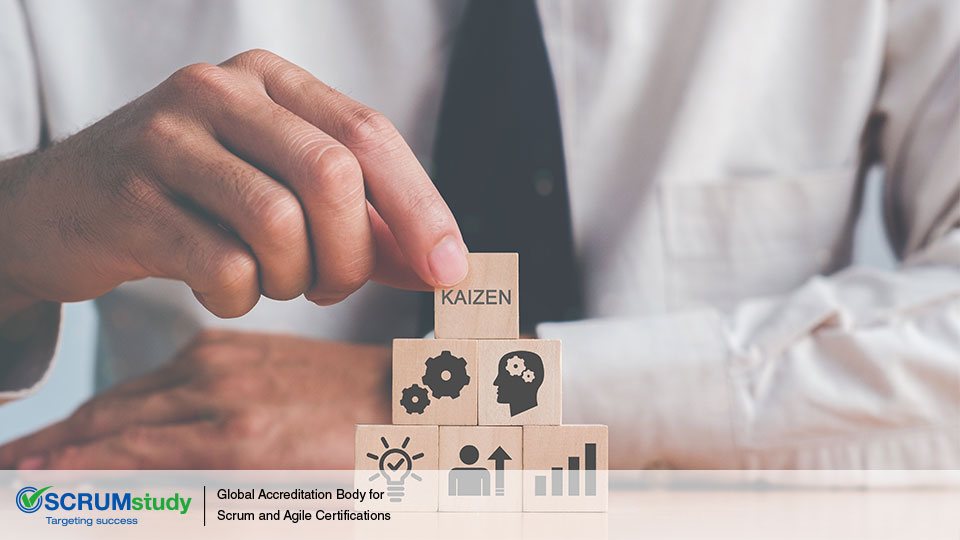
In the realm of product management, continuous improvement is vital for success. This article delves into how Agile Retrospectives and Kaizen practices can revolutionize product development. By fostering a culture of ongoing enhancement and collaboration, these methodologies empower teams to refine processes, boost efficiency, and ultimately deliver superior products. Discover how integrating these principles can transform your product management approach and drive sustainable growth.
A gathering conducted toward the close of an iteration pertaining to Agile software development is known as an Agile retrospective. The team turns back and mentally goes through the different events that occurred during the iteration and then tries to contemplate the improvement steps to go ahead.
The following questions are being asked of each team member:
• What were the good things that worked fine for the team?
• What were the unfortunate things that didn’t go well for the team?
• What feasible options and steps can be taken to improve the team process in the future?
The Agile retrospective is similar to that of the review meetings conducted to learn the do’s and avoid the pitfalls. Lessons are learned from real past experience and the team focuses on the necessary changes needed for the subsequent iteration. This meeting of team members is powered by themselves as they are the ones who decide the ‘how’ part of running the meetings and improvement decisions.
A cordial and transparent atmosphere based on the foundation of trust is very much needed for team members to share their ideas and inputs in a relaxed manner. Primary importance is being given to continuous improvement in Agile development; hence conducting these Agile retrospective meetings should be ingrained among all members of the team as one of the most significant development practices of Agile.
Kaizen is synonymous with continuous improvement, which is once again synonymous with quality, as it has a long-term perspective toward work that methodically pursues accomplishing slight, incremental changes in processes for improving efficiency and quality. Kaizen has wide applicability to varied types of work; however, it is famous for its effectiveness in lean programming and lean manufacturing.
Project teams or organizations understand well that embracing Kaizen means that the sole responsibility for continuous improvement is that of all team members working on the particular project or staff working in the organization. Dr. Deming’s famous 14 Points from his book ‘Out of the Crisis’ still aid many by serving as management guidelines. He has been, time and again, credited with the philosophy fueling kaizen.
Scrum Product Management In Agile
Posted bySCRUMstudy® on July 09, 2024
Categories Agile Product Owner Scrum Scrum Master Training
In the realm of product management, continuous improvement is vital for success. This article delves into how Agile Retrospectives and Kaizen practices can revolutionize product development. By fostering a culture of ongoing enhancement and collaboration, these methodologies empower teams to refine processes, boost efficiency, and ultimately deliver superior products. Discover how integrating these principles can transform your product management approach and drive sustainable growth.
A gathering conducted toward the close of an iteration pertaining to Agile software development is known as an Agile retrospective. The team turns back and mentally goes through the different events that occurred during the iteration and then tries to contemplate the improvement steps to go ahead.
The following questions are being asked of each team member:
• What were the good things that worked fine for the team?
• What were the unfortunate things that didn’t go well for the team?
• What feasible options and steps can be taken to improve the team process in the future?
The Agile retrospective is similar to that of the review meetings conducted to learn the do’s and avoid the pitfalls. Lessons are learned from real past experience and the team focuses on the necessary changes needed for the subsequent iteration. This meeting of team members is powered by themselves as they are the ones who decide the ‘how’ part of running the meetings and improvement decisions.
A cordial and transparent atmosphere based on the foundation of trust is very much needed for team members to share their ideas and inputs in a relaxed manner. Primary importance is being given to continuous improvement in Agile development; hence conducting these Agile retrospective meetings should be ingrained among all members of the team as one of the most significant development practices of Agile.
What are the primary benefits of obtaining a Professional Product Owner Certification for advancing one's career and enhancing product management skills?
Posted bySCRUMstudy® on June 14, 2024
Categories Certification SBOK® Guide Scrum Training
Product Owner certification offers significant advantages to professionals aiming to excel in Agile product management roles. It validates expertise in Agile principles and practices, particularly within the Scrum framework, ensuring a deep understanding of product backlog management, stakeholder collaboration, and iterative product development.
SCRUMstudy Certification offers numerous benefits, including enhanced knowledge of Agile principles and Scrum practices, improved team collaboration, and increased career opportunities. It validates expertise in Scrum, boosting credibility with employers. Certified professionals are better equipped to manage projects efficiently, ensuring high-quality product delivery and fostering continuous improvement within teams.
Scrum Master Certification offers numerous benefits for professionals in the field of project management and agile methodologies. Firstly, it provides formal recognition of one’s expertise and knowledge in Scrum practices, enhancing credibility and career prospects. Scrum Master Certified (SMC) professionlas are equipped with the skills to effectively lead Scrum teams, improve team collaboration, and facilitate project success by ensuring the proper implementation of Scrum principles. The certification also opens up opportunities for higher-paying roles and positions in reputable organizations. Additionally, CSMs often experience personal growth through the development of leadership and coaching abilities, and they become valuable assets to any agile team, driving efficiency, productivity, and continuous improvement.
Earning a Scrum certification, as emphasized in the Scrum Body of Knowledge (SBOK Guide), offers a myriad of benefits for both individuals and organizations. For individuals, it validates their expertise in Scrum practices, boosting their credibility and career prospects in the agile project management domain. Certified professionals gain a deep understanding of Scrum principles and the ability to implement them effectively, leading to improved team collaboration and project outcomes. For organizations, having certified Scrum practitioners ensures a consistent and high-quality application of Scrum processes, enhancing project efficiency and success rates. Additionally, certified teams are better equipped to handle complex projects, adapt to changing requirements, and deliver value incrementally. Overall, Scrum certification fosters a culture of continuous improvement, innovation, and alignment with industry best practices, driving both personal and organizational growth.
Although there are many certifications such as ITIL, PRINCE2, which are implemented in organizations for achievement of goals through a project, Scrum training or Scrum certification can be described as one of the many courses where employees are groomed to become self-motivated and become keen to accept greater responsibility.
There is a famous proverb, “If you are comfortable with yourself, you will definitely be comfortable with others.” It also means the importance of self-confidence which points to becoming a self-organized individual in one’s life. Scrum certification emphasizes on the importance of self-organization which ultimately results in the following:
- Team participation and a feeling of self-ownership in members
- Employees are self-motivated which can lead to improved performance in a team
- New environment that is preferable for growth
A self-organized team does not convey the message that any team member can act in his/her own way as per their wishes. It strongly means that as soon as the definition of Product Vision is created in the Create Project Vision process, the concerned team members, the Product Owner, Scrum Master and the members of the Scrum team become noted and identified individuals. It has to kept in mind that the core team of Scrum also works very closely with important business stakeholders for making changes and better improvements as they all pass through the Develop Epics and Create User Stories process. Every team member’s expertise is put to the test while assessing the inputs that are needed to execute the planned work of the project. The judgment aspects of all the team members are applied to every technical and management of the project during the phase of Create Deliverables process.
A Product Owner’s task as per the content of Scrum certification is to prioritize as he/she represents the Voice of Customer. The tasks of the self-organized Scrum team are to involve in break-down of tasks and estimation during the Create tasks and Estimate Tasks processes. Every team member should be aware of the work they are doing or handling as they are responsible for the tasks getting completed. One of the greatest advantages of Scrum certification or Scrum training is that in the execution of Sprint, if any of the team members require help for finishing the assigned tasks, it is addressed through the regular interaction that is mandatory during the Daily Standup Meetings. The members of the Scrum Team regularly interact with other teams via the Scrum of Scrums (SoS) Meetings and they can look for additional guidance when needed from the Scrum Guidance Body.
Since meetings are held regularly with customers and business stakeholders, every sprint will bear the required changes and improvements needed and at last, the Scrum Teams would have designed the product or service as accepted by the clients.
Agile Product Management Tools
Posted bySCRUMstudy® on June 13, 2024
Categories Agile Product Owner SBOK® Guide Scrum Guide Scrum Team

Agile Product Management Tools are essential resources for modern product development teams seeking to streamline their workflows, enhance collaboration, and deliver value to customers efficiently. These tools are designed to support Agile principles and methodologies, enabling teams to manage product backlogs, prioritize features, track progress, and gather feedback effectively. Examples of Agile Product Management Tools include Jira, Trello, Asana, Rally, Targetprocess, and Productboard, among others. These tools provide features such as user story management, sprint planning, burndown charts, and integration with other software development tools. By leveraging Agile Product Management Tools, teams can increase transparency, adaptability, and responsiveness, ultimately delivering products that better meet customer needs and market demands. These tools play a crucial role in fostering collaboration among cross-functional teams, enabling them to work cohesively towards achieving product goals.
Agile Team Management Tools encompass a range of techniques and practices tailored to enhance collaboration, productivity, and adaptability within Agile teams. These tools include Daily Stand-up Meetings, Sprint Planning Meetings, Retrospective Meetings, and Kanban boards. Daily Stand-ups facilitate daily synchronization and progress updates, ensuring transparency and alignment among team members. Sprint Planning Meetings enable teams to define sprint goals and commit to deliverables, fostering clarity and accountability. Retrospective Meetings promote continuous improvement by reviewing past sprints to identify successes and areas for enhancement. Kanban boards visually represent work items and their status, facilitating workflow management and task prioritization. Together, these tools support Agile principles of iterative development, customer collaboration, and rapid response to change, essential for successful project outcomes.
Open communication and transparency play crucial role in Scrum projects. Unlike the popular view that most meetings are waste of time, Scrum lays a lot of emphasis on conducting highly focused, time-boxed and effective meetings to allow transparency and free flow of information.
In this article we are going to briefly look at some of the more important meetings in Scrum.
Prioritized Product Backlog Review Meetings
The Product Owner may have multiple and separate meetings with relevant Business Stakeholder(s), the Scrum Master, and the Scrum Team to ensure that he or she has enough information to make updates to the Prioritized Product Backlog. The intent of the Prioritized Product Backlog Review Meetings is to ensure that User Stories and Acceptance Criteria are understood and are written properly by the Product Owner so that they reflect the actual business stakeholder (customer) requirements and priorities; User Stories are understood by everyone in the Scrum Team; and that high priority User Stories are well-refined so that the Scrum Team can properly estimate and commit to such User Stories.
Sprint Planning Meeting
In Sprint Planning Meetings, the Scrum Team gets together to plan the work to be done in the Sprint. The team reviews the Estimated User Stories at the top of the Prioritized Product Backlog. The Product Owner is present during this meeting in case clarification of User Stories or priorities are required. To help ensure that the group stays on topic, this meeting should be Time-boxed, with the standard length limited to two hours per week of Sprint duration. This assists in preventing the tendency to stray into discussions that should actually occur in other meetings, like the Release Planning or Sprint Review Meetings. As part of this meeting the entire Scrum Team will commit to delivering a subset of User Stories from the Prioritized Product Backlog in the Sprint.
Daily Standup Meeting
The Daily Standup Meeting is a short daily meeting, Time-boxed to 15 minutes. Team members assemble to report their progress in the Sprint and plan the day’s activities. The meeting duration is very short, and all members of the Scrum Team are expected to attend. In the Daily Standup Meeting, facilitated by the Scrum Master, each Scrum Team member provides information in the form of answers to three specific questions:
- What have I done since the last meeting?
- What do I plan to do before the next meeting?
- What impediments or obstacles (if any) am I currently facing?
Sprint Review Meeting
The Scrum Core Team members and relevant Business Stakeholder(s) participate in Sprint Review Meetings to accept the deliverables which meet the User Story Acceptance Criteria and reject unacceptable deliverables. These meetings are convened at the end of every Sprint. The Scrum Team demonstrates the achievements from the Sprint, including the new functionalities or products created. This provides an opportunity for the Product Owner and Business Stakeholder(s) to inspect what has been completed so far and to determine if any changes should be made in the project or processes in subsequent Sprints. The Sprint Review Meeting is time-boxed to four hours for a one-month Sprint.
Retrospect Sprint Meeting
The Retrospect Sprint Meeting is Time-boxed to one hour for each week of the Sprint duration. For example, for a four-week Sprint, the Time-box for the Retrospect Sprint Meeting should be four hours. This meeting is conducted as part of the Retrospect Sprint process. During this meeting, the Scrum Team gets together to review and reflect on the current Sprint in terms of the processes followed, tools employed, collaboration and communication mechanisms, and other aspects relevant to the project. The team discusses what went well during the previous Sprint and what did not go well, the goal being to learn and make improvements in the Sprints to follow. Some improvement opportunities or best practices from this meeting could also be updated as part of the Scrum Guidance Body documents.